Meercat
The meerkat or suricate, is a small mammal and a member of the mongoose family, it inhabits all parts of the Kalahari Desert in southern Africa. A group of meerkats is called a "mob" or "gang". more...
Name
Meerkat is an English loan from Dutch meaning lake cat. However the name has been replaced by stokstaartje (little stick tail) and the word only kept it's meaning in Afrikaans and - by loan - in English.
Anatomy
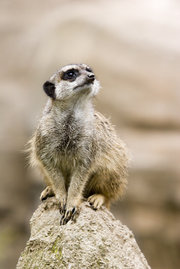
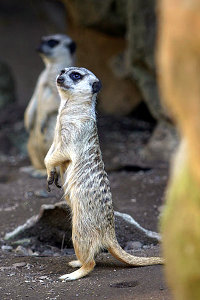
The meerkat is a small diurnal herpestid whose weight averages approximately 731 grams (males) and 720 grams (females), with long and slender body and limbs which give it a body length of between 25 and 35 cm and an added tail length of 17-25 cm. Its tail (which is not bushy like all other mongoose species) is long, thin and tapering to a pointed tip which is always coloured black, the meerkat will use its tail to balance when standing vertical. Its face also tapers coming to a point at the nose, which is brown. The meerkats eyes always have black patches surrounding them, these act like an equivalent to sunglasses and allow the animal to see very clearly on bright days, even when looking directly at the sun. This aids the meerkat greatly, as airborne predators often fly in front of the sun so as to avoid detection. The meerkat has small, black, crescent shaped ears that have the ability to close when digging to prevent sand entering.
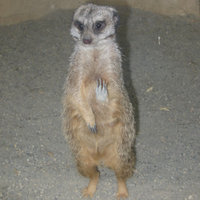
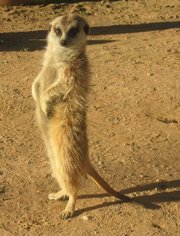
Meerkats have strong, 2 cm long, curved claws used for digging for prey and altering their underground burrows, they have four toes on each foot and long, slender limbs. The colour of the coat is usually fawn peppered with gray, tan, or brown with a silver tint. They have short, parallel stripes across their backs, these extend from the base of the tail to the shoulders and are unique to each animal. The underside of the meerkat has no markings but instead a patch on their belly which is only sparsely covered in hair and shows the black skin underneath, the meerkat uses this area on its belly to absorb heat when it stands on its rear legs, which is usually done first thing in the morning to warm up after cold desert nights.
The meerkat's diet is mainly insectivorous, but they will also consume lizards, snakes, spiders, plants, eggs and small mammals. Like all mongoose species, the meerkat has developed an immunity to many venoms, this allows them to eat scorpions (including the sting) and some snakes without fear of illness, poison or death. They have no fat stores so if they don't forage for food every day they will die.
Reproduction
Meerkats become sexually mature at about one year of age and have, on average, three young per litter and the wild meerkat will have up to three litters a year. Meerkats are iteroparous and can reproduce any time of the year but most births occur in the warmer seasons. Reports show that there is no precopulatory display, the male will fight with the female until she submits to him and copulation will begin. Gestation lasts approximately eleven weeks and the young are born within the underground burrow and are altricial. The young's ears will open at about 10 days of age, and eyes at 10-14 days, they are weaned between 49 and 63 days. They will not come above ground until at least three weeks of age and will stay with babysitters near the burrow, it will be another week or so until they join the adults on a foraging party. Usually, the alpha pair reserve the right to mate and will normally kill any young not their own to ensure that their offspring has the best chance of survival. They may also exile or kill the mothers of the offending offspring.
Read more at Wikipedia.org



 Contact
 Home
Home Aardvark