Tick
Tick is the common name for the small wingless arachnids that, along with mites, constitute the order Acarina. more...
Ticks are external parasites, living by hematophagy on the blood of mammals, birds, and occasionally reptiles and amphibians. Ticks are an important vector of a number of human and animal diseases.
Characteristics
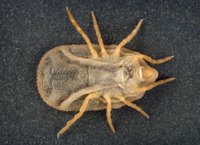
The major families of tick include the Ixodidae or hard ticks, which have thick outer shells made of chitin, and Argasidae or soft ticks, which have a membraneous outer surface. Soft ticks typically live in crevices and emerge briefly to feed, while hard ticks will attach themselves to the skin of a host for long periods of time. Most reside in the Northwestern US. Tick bites look like mosquito bites, but can also sometimes bruise or resemble a bullseye.
According to Kirby C. Stafford III, Ph.D., of the Connecticut Department of Public Health, "Concentrations of DEET that might prevent tick attachment may not deter a tick from walking across the skin to unexposed and untreated areas." DEET seems to be more effective against deterring crawling ticks when applied to clothing such as the shoe tops, socks, and lower portion of pants. Permethrin kills ticks on contact with treated clothes.
Ticks as disease vectors
Hard ticks can transmit human diseases such as relapsing fever, Lyme disease, Rocky Mountain spotted fever, tularemia, equine encephalitis and several forms of ehrlichiosis. Additionally, they are responsible for transmitting livestock diseases, including babesiosis and anaplasmosis.
Diseases such as HIV/AIDS and malaria can be transmitted by soft ticks.
Generally, tick-borne diseases correspond to a specific tick-host combination, and are limited in their geographical extent.
Location
Ticks are often found in tall grass, where they will rest themselves at the tip of a blade so as to attach themselves to a passing animal or human. It is a common misconception that the tick can jump from the plant onto the host. Physical contact is the only method of transportation for ticks. They will generally drop off of the animal when full, but this may take several days. Ticks contain a structure in their mouth area that allows them to anchor themselves firmly in place while sucking blood. Pulling a tick out forcefully may squeeze contents of the tick back into the bite and often leaves the mouthpiece behind, which may result in infection. Methods for removing a tick without it leaving its mouthpiece inside the skin include anesthetizing the tick with a substance such as ether.
According to the Rhode Island Department of Health, roughly 70% of people who develop Lyme disease catch it from ticks in their own yard. Some ways to reduce the risk of this happening include:
- Eliminating salt licks, birdbaths, and other features that attract wildlife;
- Keeping the grass short and free of clippings, leaves, and other debris that shelter ticks;
- Building a fence to keep out deer, since deer can carry hundreds of ticks;
- Creating a 3-foot wide, 3-inch deep gravel border between the yard and any adjacent wooded areas.
Walter Muma notes that the design of many suburban areas makes them prone to tick infestation:
- If your lawn is separated from the forest by only a little brush, then the border between the forest and your property is a prime area for ticks, suspended on grass and shrubs, as noted above. (Modern developers have taken great pride in providing a natural environment and saving as much of the forest in their new properties as possible. By scalloping plots out of forest, they have maximized the very border niche preferred by ticks and mice and thereby have deposited new homeowners in an optimal environment for !!) . . . ticks do not wander very far and may never see much more than a few yards of the world unless carried elsewhere by a bird, dog, deer, or human. . . In general, however, lawns are a hostile environment for ticks, as the ticks are more likely to dry out without shade and ground leaf clutter to protect them.
Facts
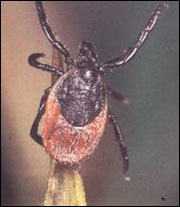
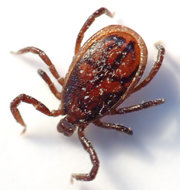
- Dermacentor variabilis, the American dog tick, is perhaps the most well-known of the North American hard ticks.
- Ixodes dammini, the deer tick, is common to the eastern part of North America and is known for spreading Lyme disease.
- I. pacificus lives in the western part of the continent and is responsible for spreading Lyme disease and the more deadly Rocky Mountain spotted fever. It tends to prefer livestock as its adult host.
- In some parts of Europe, tick-borne meningoencephalitis is a common viral infection.
- Australian tick fauna consists of approximately 75 species, the majority of which fall into the Ixodidae, hard tick, family. The most medically important tick is the Paralysis tick, Ixodes holocyclus. It is found in a 20-kilometre band that follows the eastern coastline of Australia. As this is where much of the human population resides in New South Wales, encounters with these parasites are relatively common. Although most cases of tick bite are uneventful, some can result in life threatening illnesses including paralysis, tick typhus and severe allergic reactions.
Life cycle
Deer (black-legged) tick
The deer (or black-legged) tick, and the related western black-legged tick, are the primary known transmitters of Lyme disease in the United States. Both are hard-bodied ticks with a two-year life cycle. Like all species of ticks, deer ticks and their relatives require a blood meal to progress to each successive stage in their life cycles.
The life cycle of the deer tick comprises three growth stages: the larva, nymph and adult. In both the northeastern and mid-western U.S., where Lyme disease has become prevalent, it takes about two years for the tick to hatch from the egg, go through all three stages, reproduce, and then die. A detailed description of this life cycle and the seasonal timing of peak activity, as they occur in these regions, is provided below.
Read more at Wikipedia.org




 Contact
 Home
Home Ant
Ant